
What are the best AI stocks to buy after Big Tech earnings? The more useful question may be which suppliers can turn a surge in hyperscaler spending into durabl
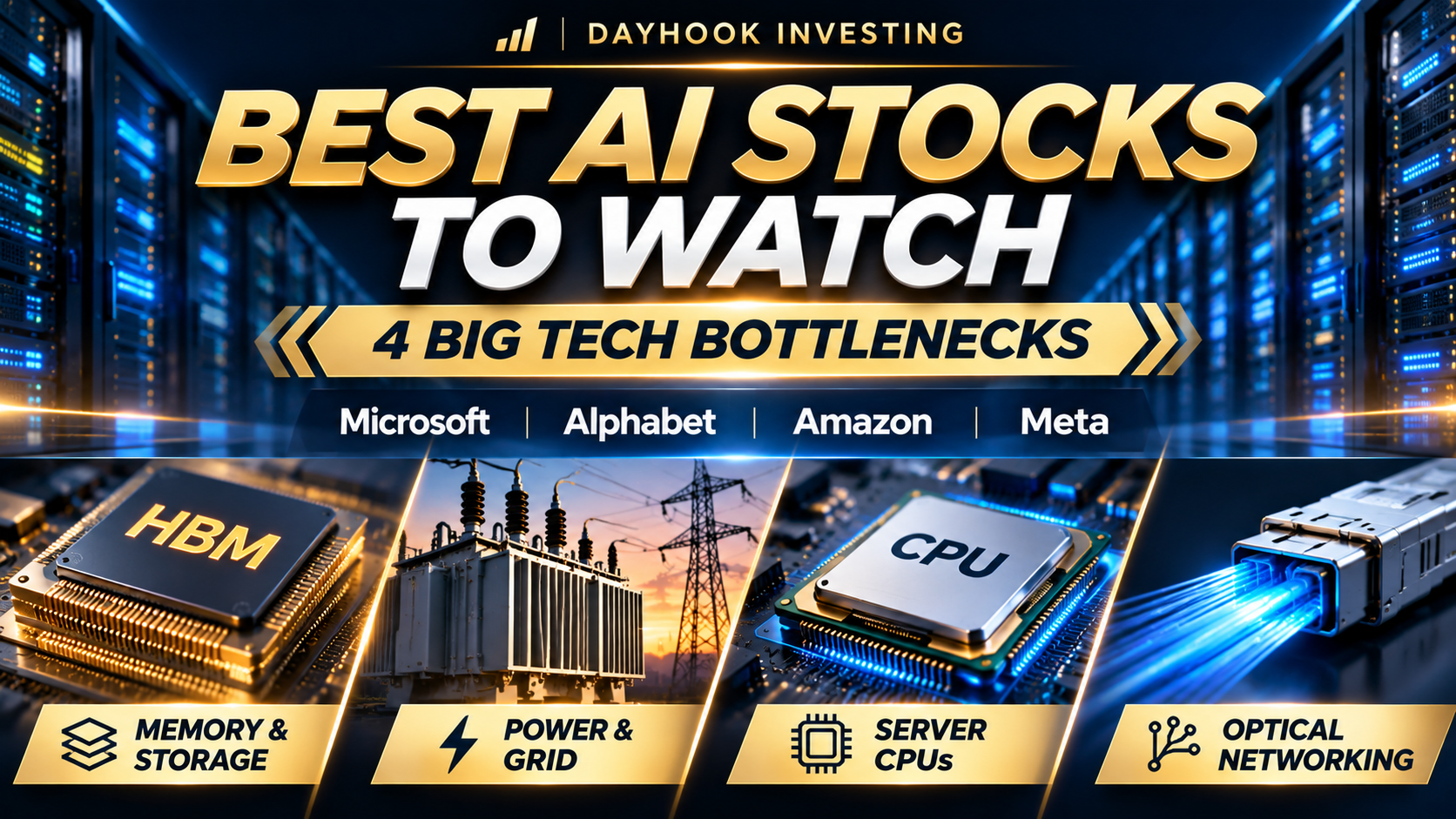
What are the best AI stocks to buy after Big Tech earnings? The more useful question may be which suppliers can turn a surge in hyperscaler spending into durable free cash flow. Microsoft’s, Alphabet’s, Amazon’s and Meta’s latest filings point to four infrastructure categories worth monitoring: AI memory, electrical power, server CPUs and optical networking. These are research themes, not a blanket buy recommendation.
Important fact-check: The source summary describes Google Cloud growth of 63%. Alphabet’s official Q3 2026 release instead reports 103% year-over-year Google Cloud revenue growth to $30.7 billion. This article uses the reported 103% figure. The spending numbers below are total corporate property-and-equipment capital expenditures, not a verified AI-only subset.
Where Big Tech Spending Flows
Cloud capex
Memory & CPUs
Power & optics
Follow orders, margins and free cash flow — not spending headlines alone.
🔎 Five key takeaways
- Google Cloud’s reported 103% growth underscores AI infrastructure demand, but revenue and profitability must be evaluated together.
- Four hyperscalers spent approximately $202 billion on property and equipment in the September 2026 quarter; these are company-wide figures.
- HBM and DRAM, grid connections, server CPUs and optical links have different supply and pricing dynamics.
- A bottleneck can create supplier pricing power but also cause project delays and higher buyer costs.
- Balance-sheet quality, backlog conversion and free cash flow matter more than AI-related branding.
📈 1. What Big Tech earnings reveal about AI spending
Alphabet reported Q3 2026 CapEx of $51.4 billion and maintained its full-year 2026 guidance of $195–205 billion. The company said approximately 65% of technical infrastructure investment in Q3 was for servers and networking and about 35% for data centers. Microsoft had previously guided to approximately $190 billion of calendar-year 2026 CapEx, including about $25 billion attributed to higher component pricing. These statements support continued investment, but they do not prove that every AI supplier will earn superior returns.
$77.3B total CapEx
$51.4B total CapEx
$39.4B total CapEx
$33.9B total CapEx
Dayhook Investing editorial illustration; conceptual, not a measured market share or forecast.
The combined figure is about $202 billion in the quarter, based on cash-flow statement line items compiled from filings. Definitions can vary and some spending supports non-AI businesses. Large spending is evidence of procurement activity, not necessarily a guarantee of future investment returns.
💡 2. Google Cloud’s 103% growth: demand, TPUs and profitability
Alphabet reported Google Cloud Q3 2026 revenue of $30.7 billion, up 103%, with cloud operating income of approximately $11.1 billion and an operating margin of 36.2%. Management identified AI infrastructure, AI solutions and TPU systems sales as contributors. TPU system sales also affect comparisons with periods when cloud revenue was dominated by traditional services.
The video summary highlights Gemini adoption, Anthropic-related demand and custom TPU usage. Those themes are plausible drivers of the broader ecosystem, but specific customer contributions should not be inferred without company disclosure. Investors should track how much growth translates into recurring revenue, operating profit and free cash flow.
Gemini, enterprise copilots and model APIs
Accelerators, server CPUs and memory
Electricity, cooling and data halls
High-bandwidth optical and network links
Dayhook Investing editorial illustration; conceptual, not a measured market share or forecast.
🤖 3. Four AI infrastructure sectors to watch
🔹 Sector A · HBM, DRAM and enterprise storage
HBM supplies bandwidth for AI accelerators, while conventional server DRAM, NAND and enterprise SSDs serve the surrounding system. Memory suppliers can benefit from tight high-performance supply, but commodity memory cycles and new capacity can reverse prices quickly. The source video claims per-user DRAM needs may rise fivefold in five years; this is a scenario rather than a verified industry forecast.
Representative names: SK Hynix, Samsung Electronics and Micron. Watch: HBM qualification, average selling prices, inventory, supply additions and customer concentration.
⚡ Sector B · Power grids, transformers and electrical distribution
Electricity access and grid interconnection can be harder to scale than server orders. Transformers, switchgear and power-management systems are necessary to energize data center sites. However, long backlogs are only valuable if projects receive permits, are delivered and convert into cash.
Representative names: Eaton, HD Hyundai Electric, Hyosung Heavy Industries and LS Electric. Bloom Energy is a separate on-site power-generation theme with different economics and technology risk.
🔹 Sector C · Server CPUs and platform architecture
Even GPU-heavy AI systems require host processors, memory management and orchestration. AMD and Intel compete in server CPUs while Arm licenses architectures used in some custom server designs. CPU supply is not interchangeable with advanced packaging for accelerators: TSMC CoWoS constraints can affect certain chip packages, but do not establish a universal shortage of all server CPUs.
Representative names: AMD, Intel and Arm. Watch: server market share, performance per watt, software compatibility, manufacturing yields and hyperscaler custom-silicon adoption.
🔹 Sector D · Optical networking, transceivers and photonics
As AI clusters scale, bandwidth and power-efficient interconnects become more important. Optical transceivers and laser components can benefit from higher port speeds and additional links. The source summary’s claim that interconnect demand scales universally with the square of GPU count (N²) is not a general engineering law; topology, network oversubscription and workload determine actual requirements.
Representative names: Coherent and Lumentum. Watch: 800G/1.6T adoption, customer qualifications, laser yields, product mix and pricing.
HBM yield, DRAM pricing and inventory
Transformer lead time and backlog conversion
Share, platform efficiency and margins
Port speed, shipments and gross margin
Dayhook Investing editorial illustration; conceptual, not a measured market share or forecast.

⚡ 4. Dark horse: power semiconductors
Power semiconductors, including silicon carbide and gallium nitride devices in suitable applications, can improve conversion efficiency. But the investment case depends on system design wins, qualification, cost and thermal trade-offs—not every AI facility will automatically switch to the same technology.
📈 5. How to track real AI demand during volatile markets
OpenRouter activity: public usage dashboards can offer a directional view of third-party model traffic. They do not measure all private, first-party or enterprise AI usage, so the video’s roughly 10x growth claim should not be extrapolated to the entire market without consistent methodology.
GPU rental rates and utilization: rental quotes, contract terms, chip generations and observed availability can indicate supply-demand conditions. Public spot prices are imperfect proxies for private long-term hyperscaler contracts.
Tokens, cloud revenue and deployed workloads
Lead times, capacity and utilization
Pricing, margins and cash conversion
Free cash flow, leverage and expectations
Dayhook Investing editorial illustration; conceptual, not a measured market share or forecast.
USUNITED STATES
- Micron Technology (MU)
- Eaton (ETN)
- AMD (AMD)
- Coherent (COHR)
- Lumentum (LITE)
ININDIA
- ABB India (ABB.NS)
- Bharti Airtel (BHARTIARTL.NS)
- Larsen & Toubro (LT.NS)
- Tata Consultancy Services (TCS.NS)
- Tech Mahindra (TECHM.NS)
KRSOUTH KOREA
- SK Hynix (000660.KS)
- Samsung Electronics (005930.KS)
- HD Hyundai Electric (267260.KS)
- Hyosung Heavy Industries (298040.KS)
- LS Electric (010120.KS)
🔴 Bottom Line: Top Picks 15
This watchlist includes five US, five Indian and five South Korean listed companies to retain Dayhook Investing’s global research format. Indian companies are primarily indirect cloud, connectivity, engineering or enterprise-AI exposures rather than direct HBM, CPU or optical suppliers. Selection is thematic, not a claim that all fifteen are attractive at today’s valuations.
🤖 What could break the AI infrastructure bull case?
- Hyperscalers reduce capital spending after disappointing returns on deployed compute.
- Memory manufacturers add capacity faster than demand and trigger a pricing reversal.
- Grid permits, transmission access or financing delay data center projects.
- Custom accelerators or network architectures change the supplier mix.
- High stock valuations leave little room for earnings misses despite solid industry growth.
🔹 Frequently asked questions
📈 What are the best AI infrastructure stocks to buy?
There is no universal best stock independent of price and risk. Investors can screen memory, power, CPU and optics companies for competitive position, balance-sheet strength and valuation.
💡 Why did Google Cloud grow so quickly in Q3 2026?
Alphabet cited AI infrastructure, AI solutions, core cloud demand and TPU system sales. It reported 103% year-over-year segment revenue growth.
📈 Are AI memory stocks safer than GPU stocks?
No. Memory suppliers face cyclical pricing and manufacturing investment, while GPU suppliers face platform competition and customer concentration. Compare cash flow and valuations.
🔹 Is transformer demand guaranteed to rise?
Not guaranteed. Power grid expansion and data center projects create demand, but permitting, utility budgets and order timing can shift.
🔹 Do optical links scale as N squared with GPUs?
Not as a universal rule. Actual optical port requirements depend on network architecture, topology, oversubscription and workload.
💡 Why do the target price buttons open a search?
They open current external analyst-consensus research in a new tab rather than presenting unverified targets. Confirm the exchange, analyst coverage and publication date.
📈 Related Dayhook Investing research
- Why Are AI Stocks Dropping? Five Risks Behind the Nasdaq Sell-Off
- AI Token Boom: Semiconductor, Memory and Cybersecurity Stocks
- Best AI Stocks: Nvidia, Google and the AI Value Chain
🔹 Sources and editorial methodology
- Alphabet Q3 2026 earnings release (SEC)
- Alphabet Q3 2026 earnings call
- Microsoft fiscal 2026 Q3 earnings call
- Hyperscaler capital expenditure tracker, citing filings
- Reuters: AI investment and free cash flow
Editorial note: This article adapts a user-supplied earnings commentary summary. Official disclosures take precedence when they conflict with the source summary. No measured Google Keyword Planner search volumes or SEO competition scores were available, so keyword selection is editorial rather than a claim of verified ranking difficulty.
Disclaimer: For informational and educational purposes only. This is not personalized financial advice or a recommendation to purchase securities. Research consensus targets independently and consider the possibility of capital loss.